
Completed project · Carrollton, TX
Rebuilding an Old Stone Retaining Wall in the Same Materials in Carrollton, TX
The stone itself was fine; what was underneath it was not. We took the wall down, rebuilt the base and drainage, and put the same stone back up.
Get Your Free Estimate
Free strategy consultation · Response within 1 business day
 4.8106 Google reviews
Project at a glance
- Location
- Carrollton, TX
- Service
- Retaining wall rebuild
- Retained
- The original stone, cleaned and re-laid
- Renewed
- Base, drainage and backfill
- Setting
- Street-side wall beneath a boundary fence
- Warranty
- 5-year JCL workmanship warranty
- 4.8across 106 Google reviews
- BBB A+accredited business
- 5-yearwarranty on every wall
- Since 2006same DFW ownership
- Freesame- or next-day estimates
Before & after
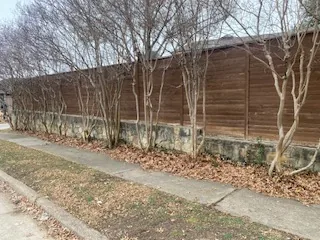
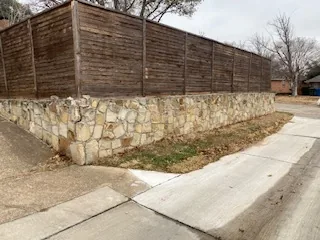
Before and after: same stone, properly rebuilt
The same wall, before and after. The stone in the finished photo is largely the stone that was there before — what changed is everything behind and beneath it.
When a rebuild beats a replacement
There is a reflex to answer every failing retaining wall with a new one in a better material. Sometimes that is right. But where the wall is already stone, and the stone itself has not deteriorated, replacing it means throwing away the most expensive part of the job.
Stone does not have a service life in the way timber does. It does not rot, it does not compress, and it does not corrode. When a stone wall goes out of shape, the stone is almost never the thing that failed — the base under it or the drainage behind it is.
That was the case here. The wall had bellied and its courses had lost their line, and the face was stained and overgrown where water had been running across it rather than through it. The stones themselves came out sound.
So the job was a rebuild rather than a replacement: take the wall down, put in the base and drainage it never had, and re-lay the same material properly. The owner gets the same wall they have always had, doing the job it never quite did.
How the wall was rebuilt
-
Free on-site estimate
Robert checked whether the stone was genuinely reusable before quoting it as a rebuild. Where stone is spalling or badly weathered that changes the answer.
-
Clearing and taking down
The growth in front of the wall came off, then the wall was taken down course by course with the stone set aside rather than broken out.
-
Sorting the stone
The stone was cleaned and sorted — face stones, hearting and any pieces past use. Sorting at this stage is what makes the rebuilt face look deliberate.
-
Excavation and base
The wall line was excavated properly and a compacted base put in. This is the part the original wall never had, and the reason it moved.
-
Re-laying to a batter
The same stone re-laid with each course stepped back into the slope, so the wall leans into the load instead of standing square against it.
-
Drainage and backfill
Aggregate behind the wall with a route out, then backfill compacted in lifts — the second thing the original wall did not have.
-
Clean-up
Sidewalk and street frontage swept and washed, and the grade tied back into the lawn either side.
Why it lasts
What actually failed, and what fixed it
A rebuild is only worth doing if it addresses the reason the wall moved. Reusing the stone is the economical part; these are the parts that make it last.
A base that was never there
Older walls were often laid straight onto the ground. Without a compacted base, the wall settles unevenly and the courses lose their line — which is exactly what the before photo shows.
Drainage behind the face
Water that cannot get through a wall goes around it or pushes it. Aggregate and an outlet give it a route, so the wall is never holding back water as well as soil.
Re-laid to a batter
Stepping each course back means the wall’s own weight works against the load. It is why dry-stone walls built this way outlast the people who built them.
The stone was fine
Reusing sound stone is not a shortcut — it is the sensible call. It costs less, it keeps the wall looking like it belongs to the house, and the material was never the failure.
★★★★★
“JCL did a fantastic job on my failing retaining wall! My wall was leaning because it never had a…”
Michael Claeson5-star Google review for JCL Landscape Services
Get a free estimate on your Carrollton retaining wall
If your wall is stone and it has started to bow or lose its line, it may be a rebuild rather than a replacement. Robert will tell you which — free, and usually same day.
Carrollton retaining wall questions
Can my existing stone be reused?
Usually, if it is sound. Stone that is spalling, badly weathered or breaking up when handled is not worth re-laying, and mortared walls are harder to salvage than dry-laid ones. Robert checks this at the estimate before quoting a rebuild.
Is a rebuild cheaper than a new wall?
Generally yes, because the material is already on site and does not have to be bought and delivered. The labour is comparable — the wall still comes down and goes back up, and the base and drainage are new either way.
Why did my stone wall move if stone lasts forever?
Because the stone is rarely what failed. It is nearly always the base settling or water building up behind the wall with nowhere to go. Fix those and the same stone will stand.
Will the rebuilt wall look the same?
It will look like the same wall, tidier. The stone is cleaned and sorted as it goes back up, so the face reads more deliberately than a wall that has been patched over the years.
How much does a retaining wall rebuild cost in Carrollton?
It depends on the length and height of the wall, how much of the stone is reusable and how much excavation the new base needs. JCL quotes a firm price at the free on-site estimate.
Do I need a permit to rebuild an existing wall?
Sometimes — it depends on the height and location, and rebuilding is not always treated the same as building new. JCL obtains and manages whatever the job requires.
Carrollton retaining walls & pool removal
JCL has built, rebuilt and replaced retaining walls across the DFW metroplex since 2006. If your wall has started to move, start here:
More recent DFW projects:
Stone wall starting to bow?
If the stone is sound, you may not need a new wall at all — just the base and drainage it never had. Estimates are free and usually same-day.