
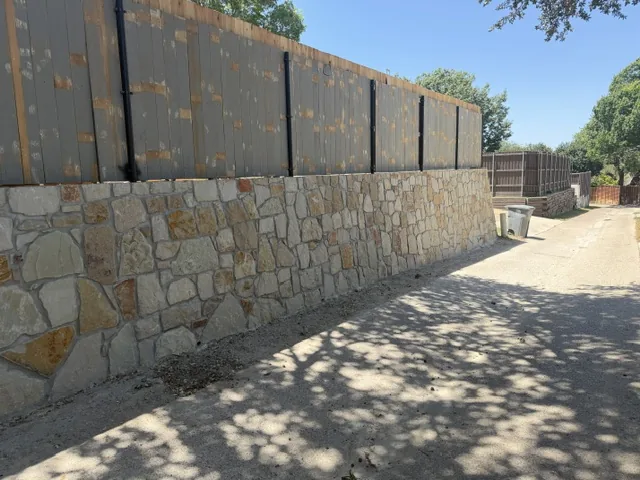
Completed project · Dallas, TX
Replacing a Failing Railroad Tie Retaining Wall With Natural Stone in Dallas, TX
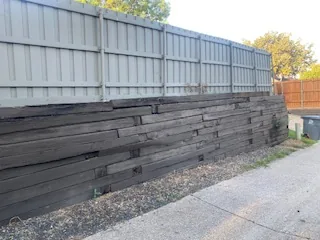
The old crosstie wall had rotted, bowed outward and started dragging the fence line with it. We took it out and rebuilt the whole run in natural stone.
Get Your Free Estimate
Free strategy consultation · Response within 1 business day
 4.8106 Google reviews
Project at a glance
- Location
- Dallas, TX
- Service
- Retaining wall replacement
- Removed
- Rotted railroad tie (crosstie) wall
- Built
- Natural stone retaining wall
- Setting
- Side-yard property line along a driveway
- Warranty
- 5-year JCL workmanship warranty
- 4.8across 106 Google reviews
- BBB A+accredited business
- 5-yearwarranty on every wall
- Since 2006same DFW ownership
- Freesame- or next-day estimates
Before & after
Before and after: crossties out, stone in
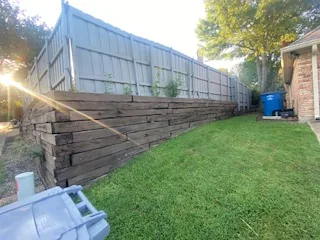
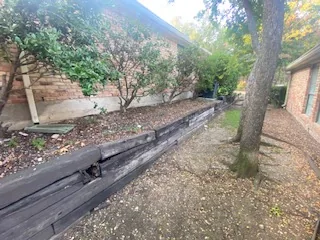
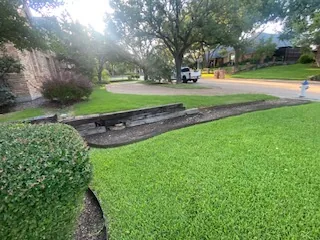
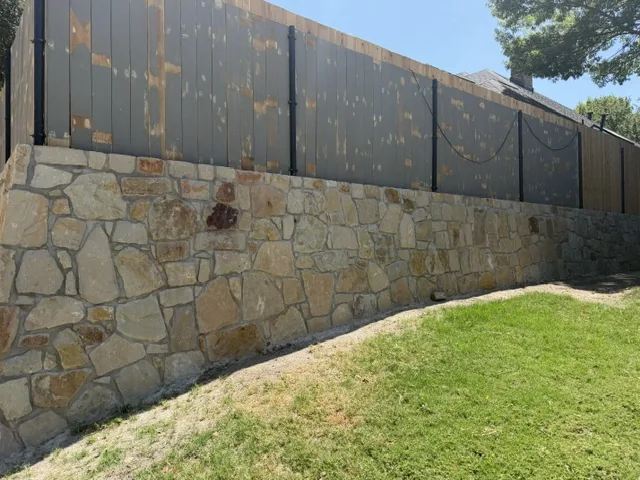
Every photo below is from this Dallas job. The first pair tells the story on its own — the same run of wall, the same fence line, photographed from the same end of the driveway.
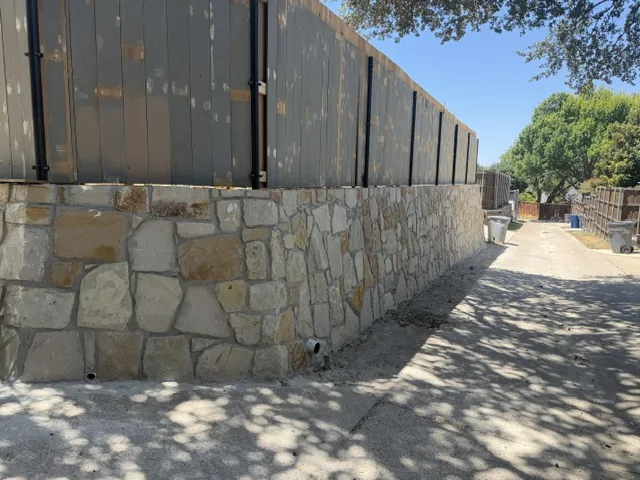
More before
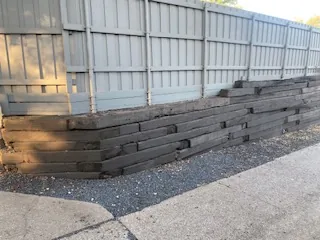
More after
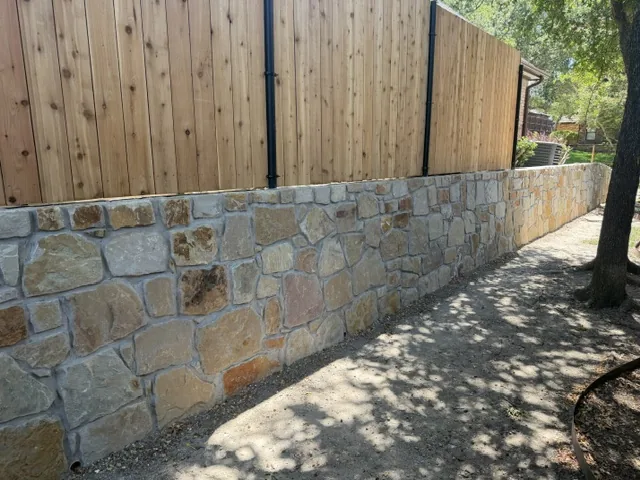
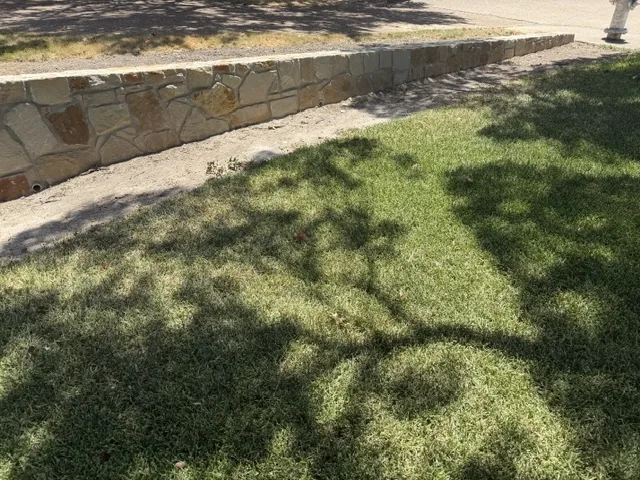
Why railroad tie walls fail in Dallas
Railroad ties were the default retaining wall material across North Texas for decades, and there are still thousands of them holding back grade in Dallas back yards. They are timber. Timber in contact with soil has a service life, and in this climate that life is usually somewhere between fifteen and twenty-five years.
What finishes them off here is the soil. Dallas sits on expansive clay that swells when it takes on water and shrinks hard when it dries out. That cycle puts lateral pressure on the back of a wall twice a year, every year. A stacked timber wall has very little to resist it with, so the courses walk forward a little at a time.
You can see exactly that in the before photos. The ties have bowed out toward the driveway, the joints have opened up, and the spikes holding the courses together have started to pull. Once the top course moves, the fence sitting on top of the slope moves with it — which is usually the point at which a homeowner calls us.
The other thing timber does is rot from the inside. A tie can look sound from the driveway and be soft enough to push a screwdriver through on the buried face. Patching a wall in that condition is money spent twice, because the courses you did not replace fail next.
How we rebuilt this wall
-
Free on-site estimate
Robert Avalos measured the run, checked what the wall was actually holding back, and priced the job on site. That price is the price — JCL does not write change orders mid-project.
-
Permits and utility locates
We pulled whatever the City of Dallas required for this wall and had the utilities located before anything came out of the ground. Permits are handled by us, not by the homeowner.
-
Demolition and haul-off
The old crossties, the spikes and the failed backfill all came out and left the property. Treated timber is not something to bury in a back yard, so none of it stayed on site.
-
Base preparation
We over-excavated behind the wall line and set a compacted base. This is the part nobody ever sees and the part that decides whether a wall is still straight in twenty years.
-
Stone laid to a batter
The wall was built in natural stone, each course set slightly back into the slope so the wall leans into the load rather than standing straight up against it.
-
Drainage and backfill
Drainage aggregate went in behind the stone so water moves down and out instead of collecting against the back face and pushing. Wet clay is the load; the drainage is what removes it.
-
Clean-up
The driveway was swept and washed and the grade tied back into the lawn. Our cleanup is the single thing customers mention most often in reviews.
Why it lasts
What makes a stone wall outlast the one it replaced
A replacement wall is only worth building if it fixes the reason the first one failed. Three things do that work here, and none of them are visible in the finished photo.
A compacted base
Stone is heavy, and weight is an advantage only if it sits on something that will not settle. A properly compacted base spreads that weight and stops the differential settlement that opens joints.
Drainage behind the face
Hydrostatic pressure from saturated clay is what pushes walls over. Aggregate behind the wall gives that water somewhere to go, so the wall is never asked to hold back water as well as soil.
Batter into the slope
Each course steps back slightly. The wall’s own mass then works against the load instead of standing perpendicular to it — the same principle that keeps dry-stone walls standing for centuries.
A material that does not rot
Stone has no service life to run out. The failure mode that took out the crosstie wall — timber decomposing in wet clay — simply does not apply.
★★★★★
“They did an outstanding job replacing old and failing railroad ties and at a cheaper price than I…”
John Stephens5-star Google review for JCL Landscape Services
Get a free estimate on your Dallas retaining wall
Tell us where the wall is and what it is doing, and Robert will come out — usually the same day or the next. You will get a firm price, not a range, and no obligation to use it.
Dallas retaining wall questions we get asked
Can a railroad tie retaining wall be repaired instead of replaced?
Occasionally, if only the top course has moved and the timber below is still sound. Far more often the ties are rotting from the buried face outward, so replacing the visible courses just moves the failure down a course. Robert will tell you honestly which one you are looking at.
How much does it cost to replace a retaining wall in Dallas?
It depends on the length of the run, how much grade the wall is holding, access for equipment, and the material you choose. JCL gives a firm quoted price at the free on-site estimate, and that quoted price is what you pay — no change orders.
Do I need a permit for a retaining wall in Dallas?
It depends on the height of the wall and where it sits on the property. JCL obtains and manages every permit the job needs as part of the work, so it is not something you have to research or file yourself.
Why do retaining walls fail so often in the DFW area?
Expansive clay. It swells when wet and shrinks when dry, and that seasonal movement puts repeated lateral pressure on the back of a wall. A wall built without drainage and a compacted base will move eventually, whatever it is made of.
How long does a natural stone retaining wall last?
Stone does not decompose, so the wall’s life is set by the base and drainage behind it rather than by the material. Built correctly it is a permanent structure. JCL warranties its workmanship for five years.
Do you work in all of Dallas or only certain neighborhoods?
We work across the whole Dallas area and 42 communities throughout the DFW metroplex, from Colleyville and Southlake in the west to Plano, Frisco and McKinney in the north.
Dallas retaining walls & pool removal
This job is one of thousands JCL has completed in the DFW metroplex since 2006. If you are looking at a wall or a pool on your own property, start here:
More recent DFW projects:
Got a wall that is starting to lean?
Catching it early is almost always cheaper than waiting, because a wall that has already dropped the grade behind it costs more to put right. Estimates are free and usually same-day.