
Completed project · North Richland Hills, TX
Partial Pool Demolition, Backfilled and Topsoiled in North Richland Hills, TX
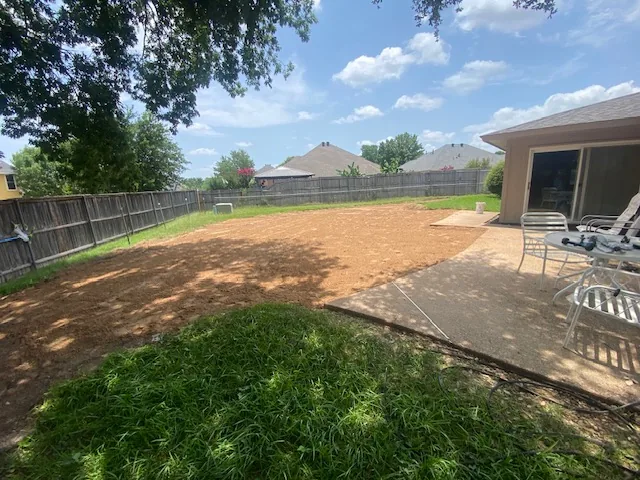
The pool came out, the void was backfilled and compacted, and the whole area was finished with a layer of topsoil ready to grow grass.
Get Your Free Estimate
Free strategy consultation · Response within 1 business day
 4.8106 Google reviews
Project at a glance
- Location
- North Richland Hills, TX
- Service
- Partial pool removal
- Removed
- Residential swimming pool
- Backfill
- Placed and compacted in lifts
- Finish
- Topsoil layer, graded ready for grass
- Warranty
- 5-year JCL workmanship warranty
- 4.8across 106 Google reviews
- BBB A+accredited business
- 5-yearwarranty on every wall
- Since 2006same DFW ownership
- Freesame- or next-day estimates
Before & after
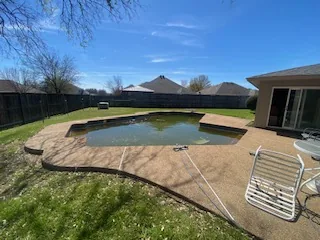
Before and after: pool to open lawn
The same back yard from the same corner of the patio. Everything that made it a pool yard is gone, and the space reads as one piece again.
The part of a pool removal nobody photographs
Most pool removal discussion stops at the demolition. Break the shell, fill the hole, done. But a homeowner does not live with the demolition — they live with the surface, and the surface is decided in the last few inches of the job.
Fill is fill. It is chosen because it compacts well and stays put, not because anything will grow in it. Seed or sod laid straight onto compacted fill gives you a pale, thin patch in the exact shape of the old pool, which is the one thing the owner was trying to get rid of.
So the final layer is topsoil, spread over the whole restored area and graded out past the edges of where the pool actually was. Carrying it beyond the pool footprint is what stops the outline showing through the lawn a year later.
This lot also had the constraint most North Richland Hills back yards have: a single gate and a neighbour’s fence a few feet away. Every load of spoil out and every load of fill in had to come through that gap, which is a scheduling problem as much as a machinery one.
How this pool came out
-
Free on-site estimate
Robert checked the pool’s construction, measured the access through the side gate and quoted a firm price for the whole job including the topsoil finish.
-
Permits and utilities
JCL pulled the City of North Richland Hills permit and had the services to the pool equipment located and safely disconnected before demolition.
-
Draining
The pool was drained to the point the city requires, and the pump, filter and associated plumbing were removed.
-
Breaking and perforating
The upper walls came off below finished grade and the floor was holed right through on a regular pattern so that water passes rather than collecting.
-
Backfill in compacted lifts
Fill went in in layers, each one compacted before the next. This is what stops the yard dishing in a year or two.
-
Topsoil and grading
A topsoil layer over the whole area, spread past the pool footprint and graded to fall away from the house.
-
Clean-up
Spoil off site, patio washed down, gate and side access left as found.
Why it lasts
What makes restored ground behave like the rest of the yard
A pool removal is judged on whether you can still see where the pool was. Four things decide that, and three of them are buried.
The floor has to pass water
An intact buried pool floor holds water like a bathtub. The ground above it stays wet, the grass above it behaves differently, and the outline shows. Perforation is not optional.
Compaction in layers
Fill placed and compacted in lifts settles a little and stops. Fill tipped in and levelled settles for years, and it does so in the exact shape of the pool.
Topsoil carried past the edges
Feathering the topsoil out beyond the pool footprint means there is no hard line where one growing medium stops and another starts.
Graded to fall away
The restored area is graded to shed water away from the slab. A flat or back-falling patch next to a house is a foundation problem waiting to happen.
★★★★★
“JCL completed a backyard transformation project that dramatically improved the usability of our…”
Jonathan Lindstrom5-star Google review for JCL Landscape Services
Get a free estimate on your North Richland Hills pool removal
Tell us roughly how big the pool is and how wide your side gate is — access is usually the thing that decides the price. Robert will come out, normally same day or next.
North Richland Hills pool removal questions
How long does a pool removal take?
Most residential partial removals are a matter of days on site rather than weeks. Access is the main variable — a yard that only opens through a single side gate takes longer to move spoil out of than one with drive-through access.
Will grass grow where the pool was?
Yes, provided there is a proper topsoil layer over the compacted fill and it is carried out past the pool footprint. Seed or sod laid directly onto fill is what produces a pale patch in the shape of the old pool.
How much does pool removal cost in North Richland Hills?
It comes down to the size and construction of the pool, how equipment reaches the back yard, and whether you need a partial or a full removal. JCL gives a firm quoted price at the free on-site estimate.
Do you need a permit to demolish a pool?
Yes. JCL obtains and manages the permit as part of the job, and the work is inspected and documented — which is what you will want on record when the house eventually sells.
Can equipment get into a small suburban back yard?
Usually, yes. Machines are chosen to suit the access rather than the other way round. Robert measures the gate at the estimate, so the price already accounts for how the work has to be done.
Will I have to tell a future buyer?
Yes — a removed pool is a material fact in Texas. The permit and the documentation from the job are exactly what a buyer’s inspector will ask to see.
North Richland Hills retaining walls & pool removal
JCL removes pools and builds retaining walls across the DFW metroplex. Whichever you are weighing up, start here:
More recent DFW projects:
Want your back yard back?
Removing a pool is usually a few days on site, and the yard is handed back graded, topsoiled and ready to grow. Estimates are free and normally same-day.